August Most Wins Final Weekend: Philly Goes From +1100 to the Driver’s Seat
August Most Wins Final Weekend: Philly Goes From +1100 to the Driver’s Seat
This is exactly the type of finish we hoped we’d get when we started building the Basewinner MLB Simulation Center.
On our August Most Wins Market: Opening Card, Philadelphia was the team that jumped off the page.
Before a game had been played in August, the Basewinner Monte Carlo simulation gave the Phillies the highest probability in baseball at 22.5%, producing fair odds of +344.
The market was offering +1100.
We made Philadelphia our Basewinner Star.
Four weeks later, the Phillies enter the final weekend 17-7 in August, and the simulation has moved them all the way to a 78.0% probability of finishing with MLB’s most wins this month.
That has made developing this product particularly fun.
Not because one good month proves anything about a model. It doesn’t. And Philadelphia still hasn’t won the market.
What has been rewarding is watching the Simulation Center behave exactly as we designed it to: start with our underlying Basewinner ratings, simulate the remaining schedule thousands of times, incorporate actual results each day and continually reprice the race.
On August 1, we were simulating an entire month.
Now we're simulating four final days.
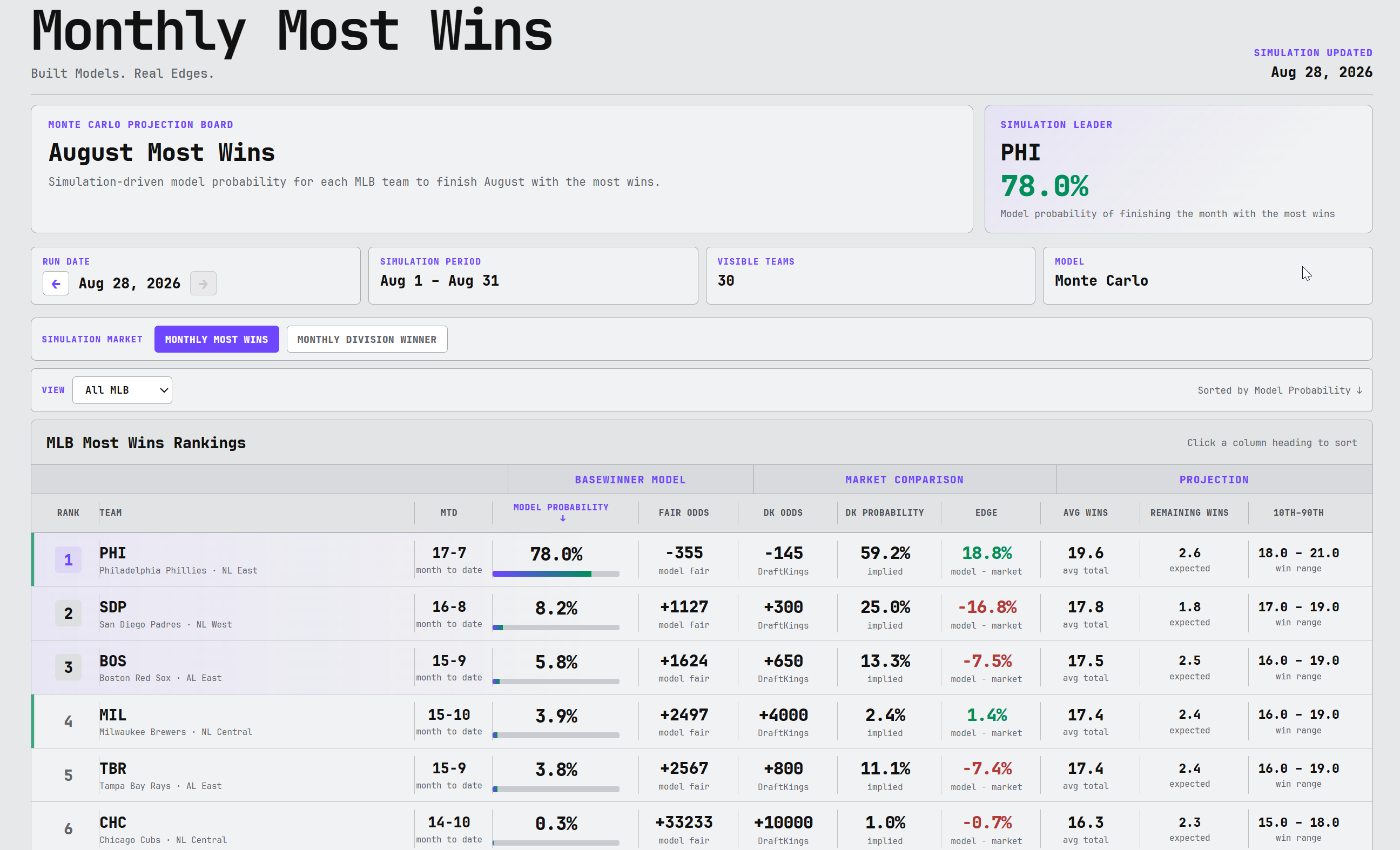
Basewinner August Most Wins Simulation — August 28, 2026. Philadelphia enters the final weekend with a 78.0% probability after opening August as the model's top team.
Philadelphia Has the Lead — and the Ratings
Philadelphia's advantage isn't merely the one-game lead.
The Phillies enter the final weekend No. 2 in the Basewinner projected run-differential rankings at +1.43 runs per game, trailing only the Dodgers.
The remaining schedule doesn't hurt either.
Philadelphia gets three games against the No. 22 Angels (-0.43) before finishing August against the No. 17 Diamondbacks (-0.26). Andrew Painter, Cristopher Sánchez and Zack Wheeler are scheduled for the Angels series.
Combine an elite underlying rating, the existing lead and that remaining schedule, and it's easy to understand why the simulation has Philadelphia at 78.0%.
The market is considerably less certain.
Philadelphia's -145 price represents approximately 59.2% implied probability, an 18.8 percentage-point gap from the Basewinner simulation.
Boston Has Something Nobody Else Does: Five Games
Boston is only 5.8% in the simulation, but the Red Sox have one interesting weapon:
Five games remaining.
Boston plays the Yankees Friday, has a doubleheader Saturday, plays the Yankees again Sunday and then hosts Seattle Monday.
That's one more opportunity than Philadelphia.
But those extra opportunities come against quality opposition. Boston is No. 6 in the Basewinner run-differential rankings at +0.72, but four games come against the No. 5 Yankees (+0.74) before a Monday matchup with No. 13 Seattle (+0.11).
Boston has opportunity.
It doesn't have much margin for error.
San Diego and Tampa Bay Can Eliminate Each Other
Philadelphia gets another subtle advantage from the schedule.
Two of its closest pursuers spend the weekend playing each other.
San Diego visits Tampa Bay for three games Friday through Sunday before the Padres head to Cincinnati Monday. Tampa Bay finishes August against the Mets.
Every Padres-Rays game guarantees that one potential Philadelphia challenger takes a loss.
And the underlying ratings make Tampa Bay particularly interesting. The Rays are No. 4 at +0.81 runs per game, while San Diego sits No. 14 at +0.05.
Yet current position matters. San Diego begins the weekend only one win behind Philadelphia and still has just an 8.2% probability of ultimately taking the overall crown. Tampa Bay sits at 3.8%.
It's a perfect example of why simply looking at the standings isn't enough.
The remaining schedule creates dependencies.
The Monte Carlo simulation captures them.
AL West: Now We Have a Sprint
If Philadelphia is about protecting a lead, the AL West is something completely different.
Houston, Seattle and Texas enter Friday with 11 August wins apiece.
The standings say they're tied.
The Basewinner ratings don't.
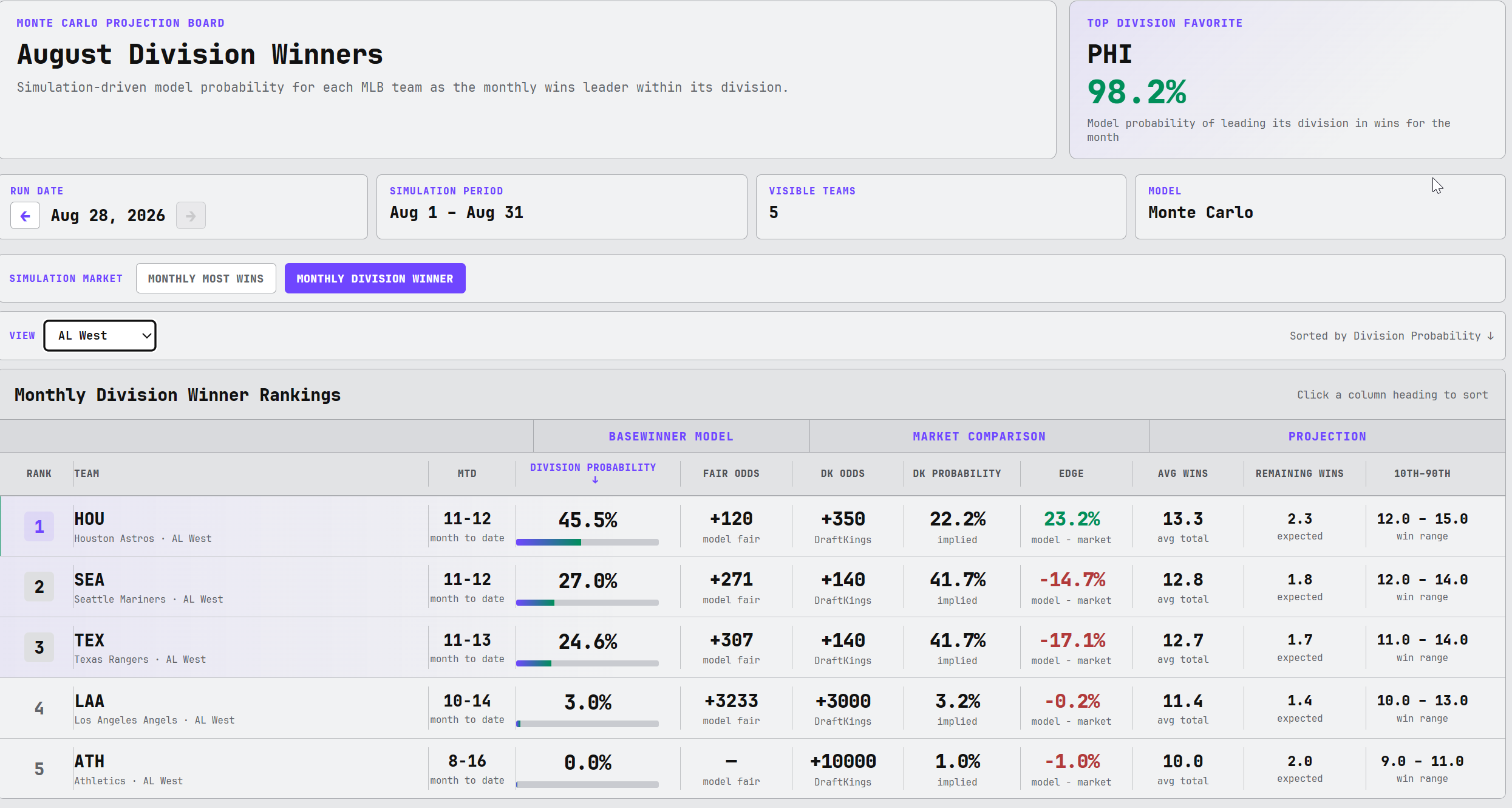
The AL West is essentially a four-day sprint. Houston, Seattle and Texas enter the final weekend tied at 11 August wins, but the Basewinner simulation gives Houston the advantage.
Houston enters the final weekend No. 10 in projected run differential at +0.38 runs per game, ahead of No. 13 Seattle (+0.11) and No. 15 Texas (-0.05).
Then look at what's ahead.
Houston gets three games against the No. 18 Mets (-0.32) before finishing August at home against the No. 19 White Sox (-0.33).
Seattle gets three against the No. 9 Blue Jays (+0.40) before traveling to No. 6 Boston (+0.72).
And Texas has perhaps the toughest immediate assignment: three games at No. 3 Milwaukee (+1.00) before finally getting the No. 24 Athletics (-0.54) on Monday.
Now Houston's 45.5% simulation probability starts making a lot of sense.
Seattle follows at 27.0% and Texas at 24.6%.
And here's where the market comparison gets especially interesting.
Houston's +350 price implies just 22.2%, roughly half the probability produced by the Basewinner simulation.
That's one of the largest model-versus-market disagreements remaining on the board.
AL Central: Just Settle It on the Field
The AL Central couldn't have been scripted much better.
Kansas City enters at 14-10.
Cleveland is 12-11.
And they play each other three times in Cleveland.
That's it for both teams in August.
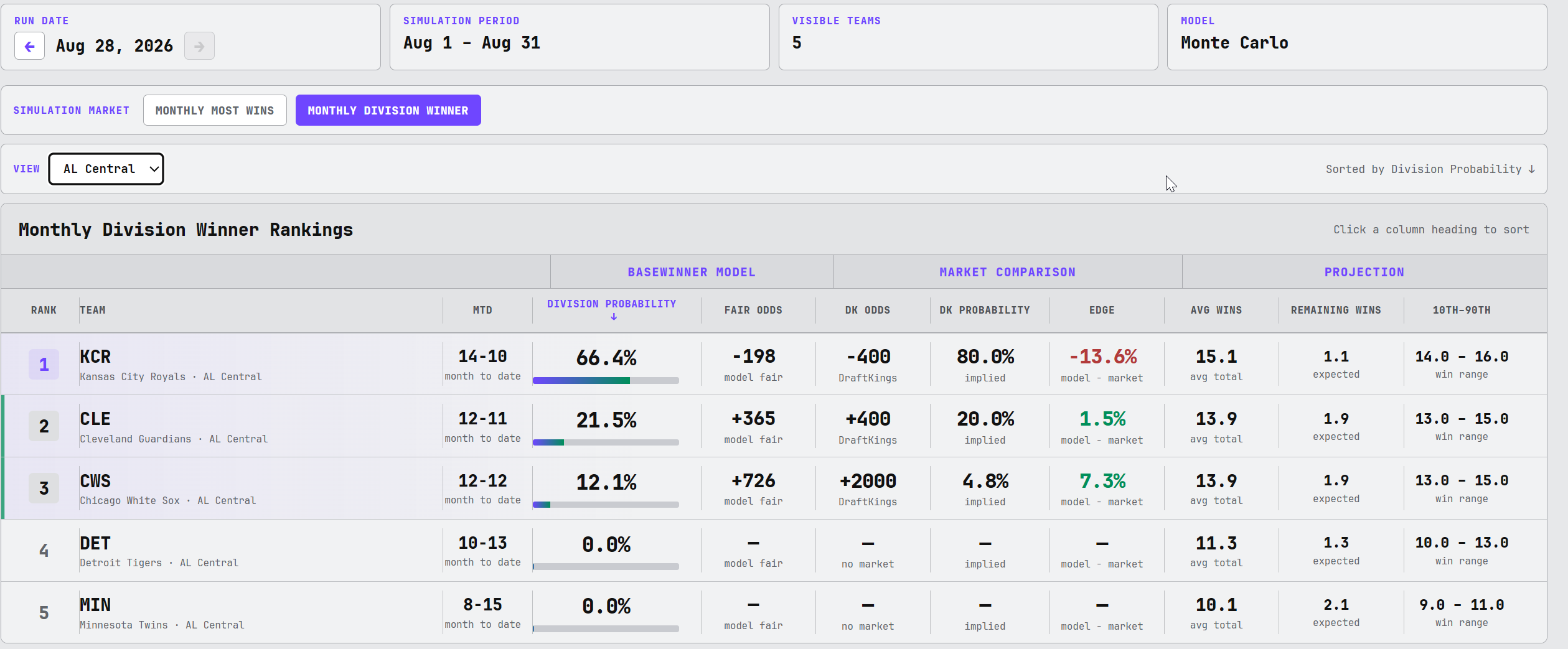
Kansas City owns the two-win cushion, but Cleveland gets three head-to-head opportunities while Chicago has four games remaining.
Kansas City has the standings advantage.
Cleveland has the Basewinner ratings advantage.
And it's not particularly close.
Cleveland enters the final weekend No. 7 in projected run differential at +0.61 runs per game.
Kansas City is No. 28 at -0.83.
That's what makes this race so fascinating.
Kansas City's two-win cushion is enough for the simulation to make the Royals a 66.4% favorite, but the substantial underlying ratings advantage for Cleveland helps explain why Basewinner isn't nearly as aggressive as the market.
DraftKings has Kansas City at -400, an implied probability of 80.0%.
Basewinner has them at 66.4%.
The model agrees Kansas City should be favored.
It just doesn't agree about how heavily.
Don't Forget Chicago
Then there's the team capable of making this race really weird.
Chicago doesn't play Kansas City or Cleveland.
The White Sox instead get four games — three at Minnesota before finishing Monday at Houston.
Chicago sits No. 19 in the Basewinner run-differential rankings at -0.33, almost identical to No. 20 Minnesota at -0.35.
Unlike Kansas City and Cleveland, however, Chicago has an extra game to work with.
That combination keeps the White Sox alive at 12.1%.
At +2000, the market is pricing them at only about 4.8%.
That's a pretty fascinating discrepancy for a team only two wins behind Kansas City with four opportunities remaining.
And Yes, Ties Matter Now
There's one more important wrinkle as the calendar runs out:
ties.
They aren't just a theoretical possibility anymore, particularly with Houston, Seattle and Texas entering the weekend with identical August win totals.
When multiple teams finish a simulation tied for the lead, the Basewinner model divides that winning outcome evenly among the tied teams. A two-team tie effectively contributes half a winning share to each; a three-team tie contributes roughly one-third.
So the probabilities on the board already incorporate the very real possibility that August ends without a single outright leader.
Four Days to Go
This first August run has been a great demonstration of what we wanted the Simulation Center to become.
On August 1, Philadelphia at +1100 was interesting because the model saw something the market wasn't fully pricing.
On August 28, Philadelphia at 78% is interesting for an entirely different reason.
Now the question isn't:
Who has the best month ahead of them?
It's:
Can Philadelphia finish what it started?
Behind the Phillies, Boston has five opportunities to make a run. San Diego and Tampa Bay spend the weekend taking wins away from each other. Three AL West teams begin the weekend tied. And Kansas City and Cleveland get to settle their race head-to-head.
The simulations have done their job.
Now we get four days of baseball to see how the distribution resolves.
Built Models. Real Edges.